



Why F1's new regulations make the Mexican GP an even bigger challenge
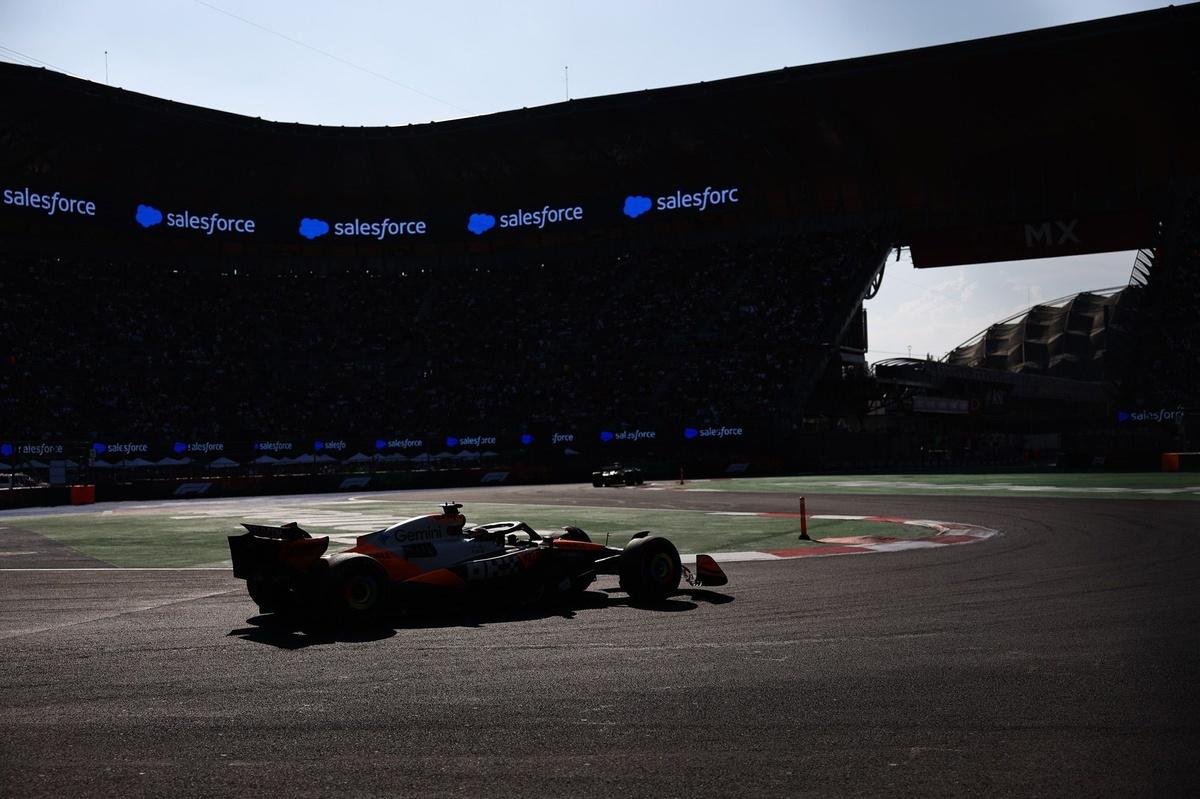
At 2,286 metres above sea level, the Autodromo Hermanos Rodriguez is by far the highest-altitude venue on the Formula 1 calendar. This naturally means thinner air, which presents a unique challenge at the Mexican Grand Prix for teams and manufacturers in two ways.
Firstly, the lower air density means that the power unit, and particularly the turbo, is put under considerable strain in Mexico. At altitude, there are fewer oxygen molecules per cubic metre, meaning the turbo has to work harder to get the same amount of oxygen into the engine as it would at sea level.
The turbo has to spin considerably faster to achieve the required boost pressure and airflow, which presents a challenge not only in terms of outright performance but also reliability, with the turbo operating at significantly higher temperatures than under normal conditions.
This is always a challenge in Mexico and also explains why George Russell pointed so clearly towards Ferrari as the favourites during Thursday's press conference, given that the Scuderia is widely known in the paddock to have a smaller turbo than many of its rivals. A smaller turbine wheel has less mass and inertia, allowing the turbo to spool up more quickly after the driver presses the throttle.
This helps to keep turbo lag to a minimum, and that is precisely what promises to be a hugely important factor this weekend. In 2026, this challenge has become considerably greater than before because the MGU-H has been removed and can no longer assist in counteracting turbo lag.
“Last year, we had the MGU-H, so we had some support from MGU-H, but this year we don't have the MGU-H anymore, so that makes it quite challenging,” Honda’s chief engineer Shintaro Orihara said when asked about the challenges by Motorsport.com.
Lance Stroll, Aston Martin Racing
Photo by: Clive Mason / Getty Images
“For example, even just in idle conditions, we had MGU-H support to get enough boost pressure, but this year we don't have any support even in idle conditions. That is a big difference from last year and therefore turbo lag is the most interesting and important topic at this track. I think that is not only the case for Honda, but for all manufacturers. They will all struggle with turbo lag at this track.”
Besides turbo lag, there is another important factor: the extent to which the engine’s power output is affected. If manufacturers cannot achieve the desired level of turbo boost in general, Honda says this could also have consequences for how it has to run the internal combustion engine – in other words, in the worst-case scenario, with a lower power output.
“Normally in Mexico, the turbo charger speed is quite high to get enough airflow. We need to check, but we may have some restrictions on the engine operation condition in the worst case. At the moment, we have done a lot of dyno testing and we believe there is almost no impact, or only a small impact on our engine operation condition, but we need to check these things in free practice,” Orihara explained.
Formula 1Why Aston Martin and Red Bull were asked about an unlikely F1 engine partnership
That “engine operation condition” naturally refers to the extent to which the internal combustion engine's maximum potential can be exploited, or whether it has to be restricted at altitude.
“Every turbo charger has some limitations in terms of its operational speed. If we hit that [maximum] operational speed and we still can’t provide enough boost pressure, then the operation point of the engine will be limited. At the moment, we don't have any concern, but we need to check this in free practice as well,” Orihara continued.
It will be particularly interesting to see how Honda performs at altitude, given that the Japanese manufacturer also struggled considerably with turbo lag in Singapore. Although it had used its second ADUO token of the season in Madrid to secretly introduce a new turbocharger, specifically to improve driveability, the issue still proved highly problematic in Singapore.
Fernando Alonso, Aston Martin Racing
Photo by: Alastair Staley / LAT Images via Getty Images
The good news, however, is that Honda has since introduced 'countermeasures' and that these had the desired effect in Austin. Mexico will provide the ultimate test, though, as Orihara is well aware.
“So in Austin, we have brought some countermeasures for turbo lag, and we have confirmed the effect of those on the lag. That was quite positive for us before coming to here,” he said.
“And also in Sakura, our facility in Japan, they are still working hard to optimise turbo lag. We have a lot of options to improve the lag. One option is our harvesting strategy with the MGU-K, so in Sakura, they are still working hard to improve the turbo lag situation.
“But even after we saw some positive signs in Austin, this is still completely different for us [with the altitude]. So it's quite important to see how our car behaves in free practice.”
As mentioned, the absence of the MGU-H makes this challenge considerably greater for all manufacturers, but that is not the only aspect of the new regulations that will affect the race weekend in Mexico. A second factor concerns active aerodynamics and its impact on the wings that teams would normally choose in Mexico.
Teams generally opt for Monaco-level wing settings in Mexico, which is relatively straightforward at altitude because air resistance is lower and the price paid in terms of drag is therefore also considerably smaller. Nevertheless, even those extreme wing choices only give drivers the downforce levels of, say, Monza-spec wings at altitude – in other words, the opposite end of the spectrum.
Max Verstappen, Red Bull Racing
Photo by: Simon Galloway / LAT Images via Getty Images
This year, however, much of that variation has disappeared because of active aerodynamics, as both Red Bull drivers explained during the media day.
“Here is a lot less grip. With the altitude, we normally have the wings to compensate a little bit for that, but now you basically just run one wing,” Max Verstappen said.
While active aerodynamics led to drivers struggling even more with the bumps in Austin – because the cars came up on the straights, giving teams a safety margin in terms of skid block wear and allowing them to run even lower through the corners – in Mexico it results in even less downforce.
It should also be noted that the 2026 cars already have significantly less downforce than their predecessors from the ground-effect era anyway. Isack Hadjar has therefore already predicted that this weekend will be “slippery as hell” for the drivers.
Formula 1Max Verstappen sits out Mexico GP FP1 for Red Bull
The new asphalt, which should theoretically provide more grip, could partly compensate for this, but it is another variable that teams have not yet been able to fully account for in their simulations, as Aston Martin's chief trackside officer Mike Krack acknowledged.
“Normally when they resurface it, the track is smooth and the grip is higher, which should help,” Krack said.
A general view of the circuit
Photo by: Steven Tee / LAT Images via Getty Images
“Obviously we lose 20-25% of density, which is the same equivalent in load. Whatever you can gain in terms of tyre-road interaction will help you. I think there will be a step in the right direction with more grip.
“Now it's often very dirty here in the first session, so the track will improve quite a lot. We are curious to see how it will change and if we can have better grip from the beginning.”
All in all, this means that Mexico's altitude presents even more challenges this year than it usually does, both on the power unit and chassis sides, and that teams are heading into the race weekend with even more question marks than normal.
Formula 1George Russell predicts key Ferrari "advantage" at F1 Mexican GP
Formula 1Fernando Alonso doubles down on poor F1 driving standards: "We all know who we're talking about"
What would you like to see on Motorsport.com?
- The Motorsport.com Team
.png)




.png)



 (1).png)