


Who slept worst last night: an F1 fan
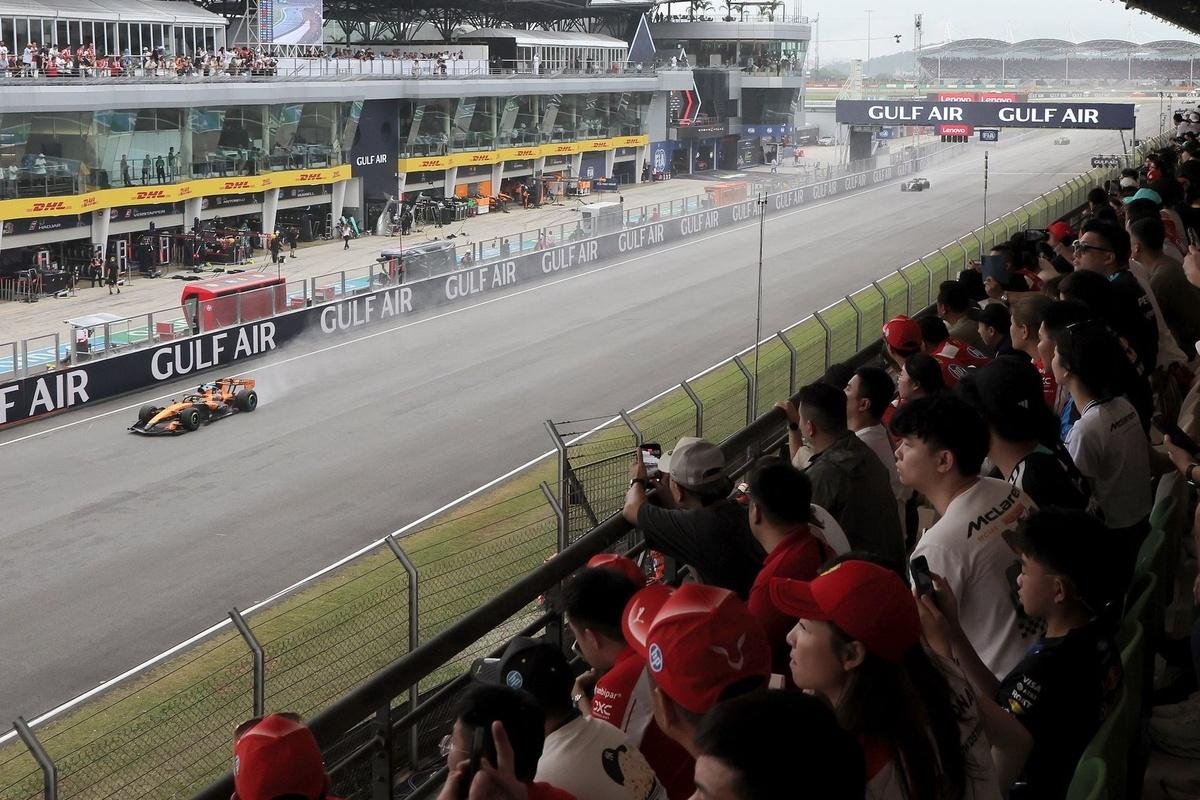
You know how you try to watch a series you like, but it’s sort of a boring episode with a lot of nothing going on – at least in the beginning – and you fall asleep in front of the TV? And have trouble sleeping through the night afterwards...
Well, that could have been one of the problems last night for Formula 1 fans around the world who had to endure an almost hour-long break in the scheduled programme of the Bahrain Grand Prix in Malaysia, seeing pictures of cars parked in the pitlane and mechanics wandering around. You wouldn’t blame anyone for falling asleep, having woken up on a Sunday morning to watch their favourite motorsport fail to start on time.
There was a delay because of the rain, yes, but those who have followed F1 for ages surely wouldn’t have been disappointed to see it pissing down when they tuned in. If you’ve been following F1 for about three decades, you surely know that feeling: it’s a good one.
Television, dialled. Ear-pleasing guitar music, like a signal for lab rats desperate for their dopamine hit, quickly crescendos. The FIA logo with an F1 car incorporated into it assembles itself on your screen. And, when you see raindrops on the helicopter camera, blood instantly rushes to your brain.
Lab rats or not, you know - you just know - you’re going to be treated to something special.
We’ve had rain delays in the past. They just added to the anticipation. They put you on the edge of your seat. F1 cars before battle, parked on a wet grid, were also a treat. The eyes of highly concentrated drivers with their helmet visors still up, staring ahead. Gladiators. Mechanics, whirring about, covering tyres with blankets. Engineers looking up at the skies. In the past, these were the best grid images ever, weren’t they? Not the ones with endless singers, actors and influencers you couldn't recognise on a clear day, let alone in the rain.
It was always - and I mean, always - worth the wait. Because something amazing was about to happen.
Picture two Ferraris, those of Michael Schumacher and Rubens Barrichello, going off the track almost simultaneously at Sepang shortly after the start, unable to control their cars on the slippery surface — only to then put on an overtaking fest, climbing back through the field amid the complete chaos of the race.
That was your 2001, dear F1 fan.
The 2001 Malaysian Grand Prix
Photo by: Rainer Schlegelmilch / Getty Images
A quarter of a century later, it was Max Verstappen and Lewis Hamilton crawling down the very same track at golf-cart speed during the formation lap ahead of a race that was about to become a thriller. Unable to control their machines with the throttle, the gladiators of modern Formula 1 appeared to be powerless, in every sense of the word. The thriller had to be red-flagged.
Dear Formula 1, you’ve ruined it.
On this particular occasion, with this particular software glitch, which threw these super-complex power units into disarray, you deprived F1’s most dedicated fans of something amazing.
It could have been a father delaying a trip with his family, for this. It could have been a kid for whom F1 is his own escape world. An old man in a retirement home who still remembers watching guys like James Hunt and Niki Lauda at Fuji fighting for the world title back in 1976.
“I wish we could go when we went, because you'd have had a nice race,” said Alex Albon, an F1 driver and surely also an F1 fan himself, after the flag.
“The track was good enough to start on the wet tyres, to race under those conditions. It would have been nice to actually get proper running in the wet with these cars and these regs.”
Formula 1Explained: What was really going on with the FIA software bug causing F1 chaos in Malaysia
Formula 1"Horrible, totally unacceptable" - Powerless F1 drivers frustrated by Bahrain F1 software glitch
There was still a decent race, it has to be said. There was a battle at the front and an overtake for the lead, a back-to-front charge from Hamilton, mixed strategies, mistakes and some drama. It was just that it wasn’t anywhere near what it could have been, leaving that sour aftertaste.
Russell felt this weekend's race day was a "faff"
Photo by: Andy Hone/ LAT Images via Getty Images
George Russell summed it up pretty well.
“The whole day felt like a bit of a faff with the delay and then the red flag and then endless laps under the safety car,” he said in the media pen. “It just didn't feel very F1 today. And I'd have been a bit disappointed if I was in the stands watching that unfold.”
Formula 1 is booming. There’s no doubt the series itself is in great shape. The best it’s ever been. Brad Pitt is shooting a sequel to the F1 movie, after all! The Netflix series is still going strong, despite the predictable decline, but, as they say, still way better than other similar behind-the-scenes semi-documentaries about other sports.
It’s also well known to those within the industry that F1’s own fan surveys return good numbers on how exciting those taking part actually find the races. The stats do look good. But do they also reflect the way those who have followed F1 for decades actually feel?
The grass will always look greener if you close your eyes and remember the races from the good old days. There were a lot of boring ones as well. There’s no doubt about that. But there were some bloody good ones, too! And it’s those that stick in the memory best.
It’s difficult to point fingers at anyone for that software glitch, which turned the hour before the actual start in Malaysia into an embarrassment. The FIA would be the usual punching bag, but first, it’s not entirely its product and the software was developed together with the teams. And second, these PUs appeared in F1 for a whole lot of different reasons - commercial ones first and foremost, as the series was trying to please the car manufacturers.
Formula 1Winners and losers from F1's bug-ridden Bahrain GP in Malaysia
They are powerful organisations, those OEMs, and there’s ultimately nothing wrong with them being associated with F1 - because they do help this boom keep booming with their marketing machines armed with cash. They bring new fans. Allegedly, at least.
The 2026 race at Sepang still delivered a decent show
But it’s those who have followed Formula 1 for decades who now ask themselves difficult questions about whether it’s still the same series they grew to love.
It’s them, the educated and knowledgeable fans, who cringe at seeing cars slowing down on the straights. It’s them exhaling at power unit-assisted overtakes. It’s them, the minority as it looks now, not enjoying it as much as they used to. And it’s them who shake their heads in disbelief at what it’s become, reading drivers’ comments about how computers decide more than they should.
It’s also true that not everyone cringes and shakes their head. But after the show F1 put on in the build-up to the Bahrain GP in Malaysia, a lot of those who actually don’t mind the yo-yo racing are probably still asking themselves whether this regulation set is indeed a step too far.
“I didn't even know that the FIA could control our throttle pedal, that was quite scary, actually,” said Oliver Bearman after the race. “I don't think they should be able to turn off our throttle pedals. I know that wasn't the goal. And maybe it could be used for good things, like in a safety car or a red flag situation. If there's a massive shunt, turn off everyone's throttle pedal. I guess it's not a bad thing.
"But in that case, it probably tells us that maybe we've gone a bit too far in terms of intervention and this low-grip mode stuff, all of those things. It's a nightmare to understand.”
I’m personally not a fan of drivers going out and slagging F1 off in the media, like they did at the beginning of the year. It would have been a lot better had those involved managed to keep the discussion behind closed doors - but maybe it’s still not such a bad thing if someone like Verstappen speaks out if he feels these regulations are what actually threaten the future of the championship they love. We love.
These people used to be called petrolheads.
Verstappen's open criticism of F1 was strong, but maybe he had a point
Photo by: Sam Bagnall / Sutton Images via Getty Images
It’s also pointless to deny progress and new technology. The world is definitely changing, and F1 absolutely has to keep up with it.
But maybe it also needs to realise and admit it simply went too far. Or at least try to do some favours for those who represented the core of its fanbase when it wasn’t exactly booming. It’s not “bring back V10s”, “ban computers” or “make everything like 2001”. Maybe start with something small: make sure that when it rains, the best drivers in the world are still able to wrestle racing cars around a wet track.
And then maybe just make these cars a bit simpler themselves, so that no one has to second-guess whether it’s the driver who made the difference or the algorithm that deployed a few more horsepower at the right moment. The petrolheads would definitely approve. And that wouldn't be such a bad thing either. Because, after all, it’s them who are likely to stay when the boom isn’t booming any longer.
What would you like to see on Motorsport.com?
- The Motorsport.com Team
.png)



.png)


 (1).png)