


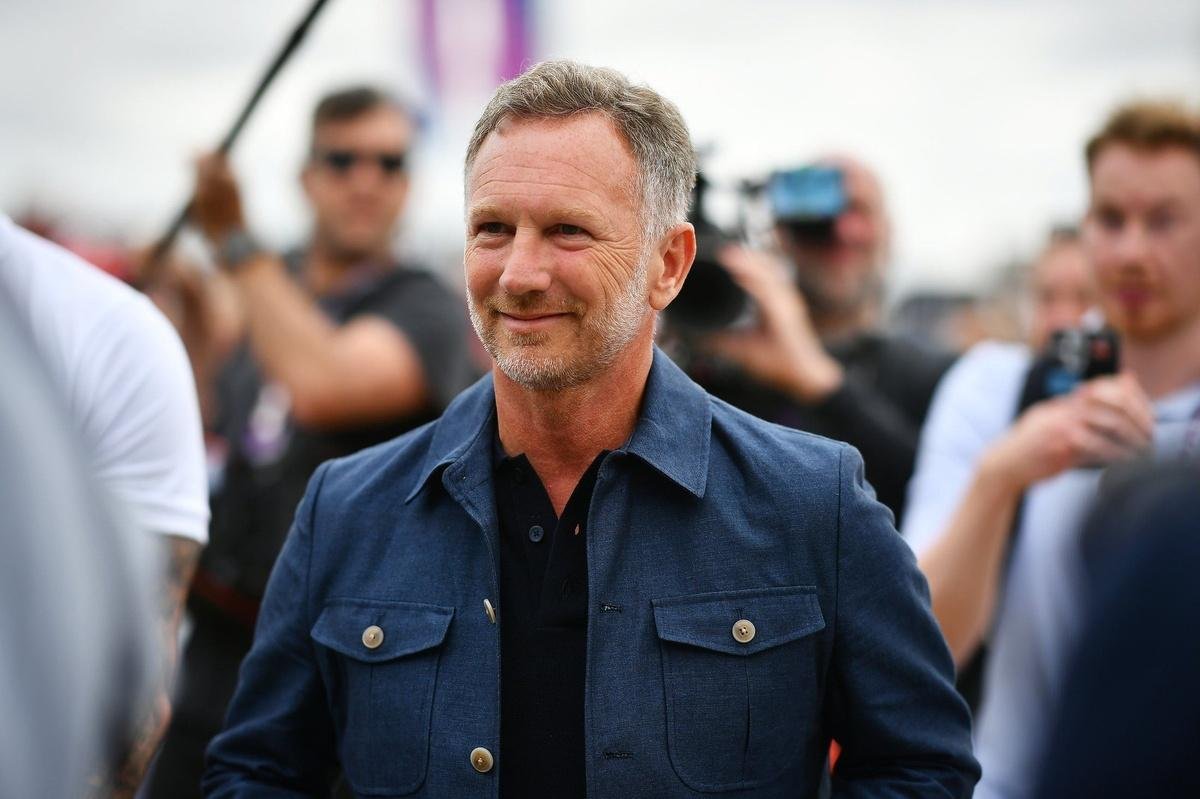
Who slept best last night: Christian Horner
Max Verstappen's victory at Sepang was an historic one. Twenty years from now, when a new generation of Formula 1 fans flicks through the history books, they may well wonder what a bizarre season 2026 must have been for the Bahrain Grand Prix in Malaysia to be hit by so much rain that the start had to be delayed.
But that's not what I mean.
It has been a very long time since a Ford engine last won an F1 race. In April 2003, Giancarlo Fisichella won the Brazilian GP in a Jordan powered by a Ford-Cosworth RS1 V10.
Back then it was a bizarre race, brought to a premature end after, incidentally, a crash involving a certain Fernando Alonso. Twenty-three years ago, Alonso was only in his second full F1 season and was neither a world champion nor a grand prix winner.
Fisichella was leading when the red flags came out at Interlagos - but initially it was McLaren's Kimi Raikkonen who was declared the winner.
The FIA Sporting Regulations at the time stipulated that, provided more than 75% of the race distance had been completed, the race would be "deemed to have finished when the leading car crossed the line at the end of the lap two laps prior to that lap during which the signal to stop was given".
The official timing screens initially showed Fisichella beginning lap 56. Then, briefly, that information disappeared, with the system instead showing him as still being on lap 55. The stewards based their original decision on the assumption that Fisichella had indeed still been on his 55th lap.
Fisichella is awarded the winner's trophy alongside Jordan after an appeal
Photo by: Motorsport Images
Eddie Jordan protested - and won.
At the following round in Imola, F1 witnessed the memorable sight of Raikkonen and Ron Dennis handing their drivers' and constructors' winners' trophies over to Fisichella and Jordan.
Of course, you can argue about whether Sepang 2026 really counts as a victory for a Ford engine. A more accurate description would probably be this: an internal combustion engine built by Red Bull Powertrains, supported by Ford with power-unit expertise and battery technology. Or, as the more cynical observers have occasionally put it: a Red Bull engine with a Ford sticker on it.
Back in March 2023, Helmut Marko himself explained it like this: "Even if the team may be called Red Bull Ford or Ford Red Bull, the engine will come solely from Red Bull Powertrains. Ford will be involved in battery technology."
Red Bull and F1 engines have always had a complicated relationship. In 2013, Red Bull was still winning world championships with Renault power. Then the French manufacturer scaled back its works involvement, and the team continued with the arrangement of running Renault engines rebadged as TAG Heuer, a set-up nobody was particularly happy with.
So Red Bull went out and found Honda. First for its "little" team, Toro Rosso, and from 2019 for Red Bull Racing as well. By the time Verstappen became world champion in that unforgettable Abu Dhabi finale in 2021, Honda had already announced that it would withdraw from F1 as a works operation. That announcement had come in October 2020, at a time when the coronavirus pandemic had sent shockwaves through the global economy.
So by the end of the 2020 season, Red Bull had a fairly serious problem to solve for life beyond 2021, as it was staring at a future without an engine supplier.
Verstappen and Honda chiefs celebrate his 2021 F1 world title win as the Japanese manufacturer prepared to leave the series
Photo by: Andy Hone / Motorsport Images
And at some point, someone must have had the idea that, after years of depending on Renault and Honda, perhaps Red Bull should simply take matters into its own hands.
Legend has it that Dietrich Mateschitz had always been irritated by the way F1's established car manufacturers looked down on Red Bull as little more than an "energy-drink company". There was something undeniably appealing about the audacity of proving them wrong: having built the best chassis in F1, why not build the best engine as well - right in the heartland of Mercedes and the traditional automotive giants?
It probably didn't take Christian Horner and Helmut Marko very long to sell their boss on the idea. Attempting things other people consider impossible has always appealed to Horner. It appealed to Mateschitz, too. You might say it's part of Red Bull's DNA.
At Red Bull's home grand prix in Austria in July 2021, Marko happened to bump into Fritz Enzinger, Porsche's motorsport boss at the time.
They got talking about what Red Bull planned to do in the wake of Honda's impending withdrawal. Enzinger let slip that Porsche might be rather interested in entering F1 itself.
The conversation between two Styrians ended in typically pragmatic fashion. Marko would push ahead on Red Bull's side with the vision of building its own engine campus in Milton Keynes. Enzinger would explore whether a Porsche F1 programme could actually work. And perhaps, somewhere down the road, the two projects could somehow be brought together.
By November 2021, everything pointed towards a Red Bull-Porsche joint venture. Mateschitz, Marko, Enzinger and Porsche CEO Oliver Blume met at Hangar-7. The atmosphere was relaxed, everyone seemed to be on the same wavelength, and the occasion was toasted with Zirbenschnaps, an Austrian pine schnapps.
Mateschitz held advanced talks with Porsche over an engine partnership with Red Bull
Photo by: Manuel Goria / Motorsport Images
The Austrians thought the whole thing was a fantastic idea. Horner, however, was beginning to wonder whether Red Bull really needed Porsche at all. In February 2022, a Porsche delegation arrived at Red Bull headquarters in Fuschl for negotiations, while Horner visited Porsche in Weissach. The prospect of no longer being able to make decisions simply with Mateschitz and Marko - and instead having to submit proposals to the board of a major corporation - did not particularly appeal to him. Eventually, the Red Bull-Porsche dream died.
But Horner had not done things by halves. Red Bull Powertrains had already been founded. The purpose-built technology campus in Milton Keynes was well under construction and engineers had been recruited from rival manufacturers.
At some point, Horner must have asked himself the obvious question: Why do we need Porsche if we can simply do this ourselves?
The idea that an energy drink company could build an F1 engine was initially met with plenty of amusement around the paddock. Mateschitz's original vision - taking on Mercedes and company with his own racing team, winning GPs and eventually world championships - had already sounded enough like a fairytale. But this? Surely Red Bull was finally overreaching. At least, that's what plenty of people who genuinely knew what they were talking about believed.
Four years later, we know the answer. Red Bull did not overreach.
And on Sunday, Horner will surely have watched events at Sepang with mixed emotions as the project that forms part of his legacy delivered a first F1 victory for a Red Bull Powertrains engine of its own making.
Formula 1F1 Bahrain GP in Malaysia: Max Verstappen wins in chaos as George Russell retires
Red Bull has beaten the might of Mercedes and Ferrari with its own engine
Photo by: Srinivasa Krishnan
People can argue endlessly about how much of Red Bull's historic success belongs individually to Mateschitz, Marko or Horner. But one thing was always clear: Milton Keynes was Horner territory. And Milton Keynes is where Red Bull Powertrains was born.
You don't have to like Christian Horner. He rather enjoys playing F1's villain, and over more than 20 years he has done precious little to rid himself of that image. Why would he?
Horner has picked fights with Toto Wolff, Zak Brown, Jos Verstappen and many others. Being everybody's darling was never part of his business model.
His autobiography, Drive, will be published on 22 October and you don't need to be a clairvoyant to guess that Horner will tell his version of the Red Bull story. How a ridiculed energy-drink company became one of the most successful teams in Formula 1 history. How Red Bull knocked Mercedes off its throne. And, presumably, why Horner played a rather important part in all of it.
After this Sunday at Sepang, one chapter of that story has already been written before the book even reaches the shelves, because Horner wasn't merely team principal when Red Bull decided to attempt something many in the paddock considered an act of megalomania.
Red Bull Powertrains grew into what it is today under his leadership. He recruited the people and drove the project forward. He was among those who eventually reached the conclusion that if Red Bull was going to build an engine factory anyway, perhaps it didn't need Porsche after all.
There is a certain irony in the fact that Horner was no longer there when Verstappen brought the project's first victory across the finish line on Sunday.
Horner won't be able to claim Verstappen's win in Sepang as part of his record, but it is a result of his legacy
Photo by: Red Bull Content Pool
Horner doesn't get the trophy and his name appears nowhere in the results. And there aren't too many people at Red Bull right now particularly eager to emphasise his contribution to this success. But history works differently.
Today, Red Bull has the most powerful internal combustion engine in F1. Thanks to the FIA's ADUO classification, that is something that can be demonstrated objectively.
Formula 1Red Bull requests FIA review of ADUO results after emerging as benchmark
Had you predicted four years ago that this was where Red Bull would end up, people would probably have called you mad. I would have too.
Horner is no longer the team principal of Red Bull Racing. Perhaps one day he will return to Formula 1. And perhaps Drive will, in places, offer Horner's version of why he was so successful.
But there is one paragraph nobody will ever be able to edit out of his autobiography: Red Bull built its own Formula 1 engine. And won a grand prix with it in its very first season.
Horner may not have spent last night in Sepang as Red Bull's team principal. But I'm pretty sure he slept well.
What would you like to see on Motorsport.com?
- The Motorsport.com Team
.png)


.png)

 (1).png)